
Photo by Eduardo Sánchez on Unsplash
I’m in the middle of listening to Cory Doctorow’s Enshittification: Why Everything Got Suddenly Worse and What To Do About It and wanted to sketch out an idea. Consider the following perspective:
Our wired devices, our relationships, and our digital identities have been hijacked by big tech to support addictive behaviors. Big tech corporations (primarily Meta, Google, and Apple, but also every corporate social media company, Amazon, and all streaming platforms and media companies) have spent the last twelve or more years modifying their products to make them cognitively, emotionally, and economically impossible for most of us to put down. We are in the middle of a multi-generational attention crisis that negatively impacts our politics, our relationships, and our well-being, and it’s being done “to” us by a folks that we willingly invited into the most private parts of our lives.
If you’re not there yet in believing that above paragraph, that’s ok. Or maybe you agree with it, but you don’t know what, if anything, you can do about it given how internet-connected technology is woven so thoroughly into the patterns of our lives.
Either way, it is helpful to think about big tech from the language of “harm reduction” developed in communities fighting substance abuse behaviors.
Can we go “off the internet,” cold turkey? Not really (well, you can, but you would probably have to get a new job and move completely off the grid; it sounds nice sometimes), at least, not many of us. However, we can approach big tech products and the behaviors they encourage as something that we can step away from in varying degrees in order to reduce their negative impacts.
For context, here is a timeline of some of my reading and decision-making in the last several years with respect to big tech. This list reveals how my understanding of being a digital citizen has developed (and, to be honest, become more cynical and guarded) over the last seven years:
“Corralling digital notifications,” my blog post from Mar 2019
The Great Hack documentary is released, July 2019
Permanent Record, by Edward Snowden, published Sept. 2019
The Social Dilemma documentary is released, Jan 2020
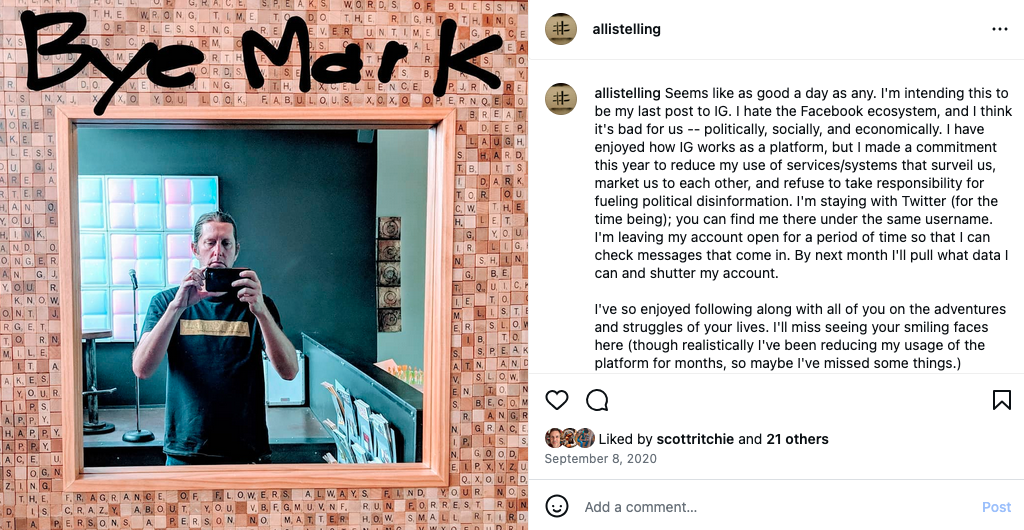
I left Instagram, Sept, 2020
“Leaving Gmail”, my blog post from Jan. 2021
“Quit Google,” my conversation with Tim Owens of Reclaim Hosting, July 2021
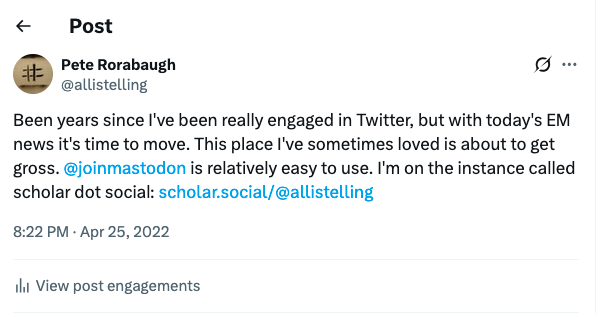
I left Twitter, April 2022
Stolen Focus, by Johan Hari, published Jan. 2023
The Chaos Machine, by Max Fisher, published Oct. 2023
“Why Mastodon” my blog post from July 2023
Enshittification, by Cory Doctorow, published Oct. 2025
I am cancelling Amazon Prime, Jan 2026
The challenging thing for me over the last 15 years is that I began my career in higher education with an energetic embrace of digital media. While I was a post-doc at Georgia Tech, I began incorporating Twitter into classroom discussions; I co-founded a journal that celebrated the development of pedagogical approaches to new media; I began collaborative writing with students in Google Docs to invite new ways to approach the composition process. All of these parts of my identity as a “digital pedagogue” have been eroding for the last decade as we have learned the results of being spied on, monetized, and emotionally manipulated by networked technologies.
A small piece of good news: we still have agency to reverse course. If we educated ourselves and start small, we can increasingly sever big tech’s pipeline to our imaginations, our political deliberations, and our buying habits. We can start unplugging from technologies that lock us into unfavorable terms and conditions, that leave us feeling like we’re stuck using a platform that we don’t like, that capture and sell our data. Sometimes this means dropping proprietary big tech platforms (X, Google) for open-source options (Mastodon, Proton); sometimes it means stepping away from a product entirely because its harm is just too great (generative AI products, smartphones).
Another piece of good news: leaving big tech doesn’t necessarily mean having to leave “the internet.” Plenty of healthy, resource-rich, communally developed tools still exist to create, collaborate, deliberate, and organize well with others outside corporate, proprietary hands. Blogging via open source platforms (like this WordPress post you’re currently reading) keeps data in the hands of users and out of the toxic algorithms of social media platforms. I’ve been enjoying introducing students to web domain ownership and open source blogging for over a decade, and it carries with it great lessons about how the web works and to assert agency over your own digital experience.
As we start 2026, consider your relationship to your phone, your social media accounts, your search engine, your browser. Consider how one-sided your relationship is with the companies that make those products. Harm reduction might be a useful framework to imagine changing those relationships. Taking small steps away from the companies who are harvesting our data and our attention might give you a sense of agency and greater feeling of control. It will definitely give you more time to spend, intentionally, on your own, healthier goals.