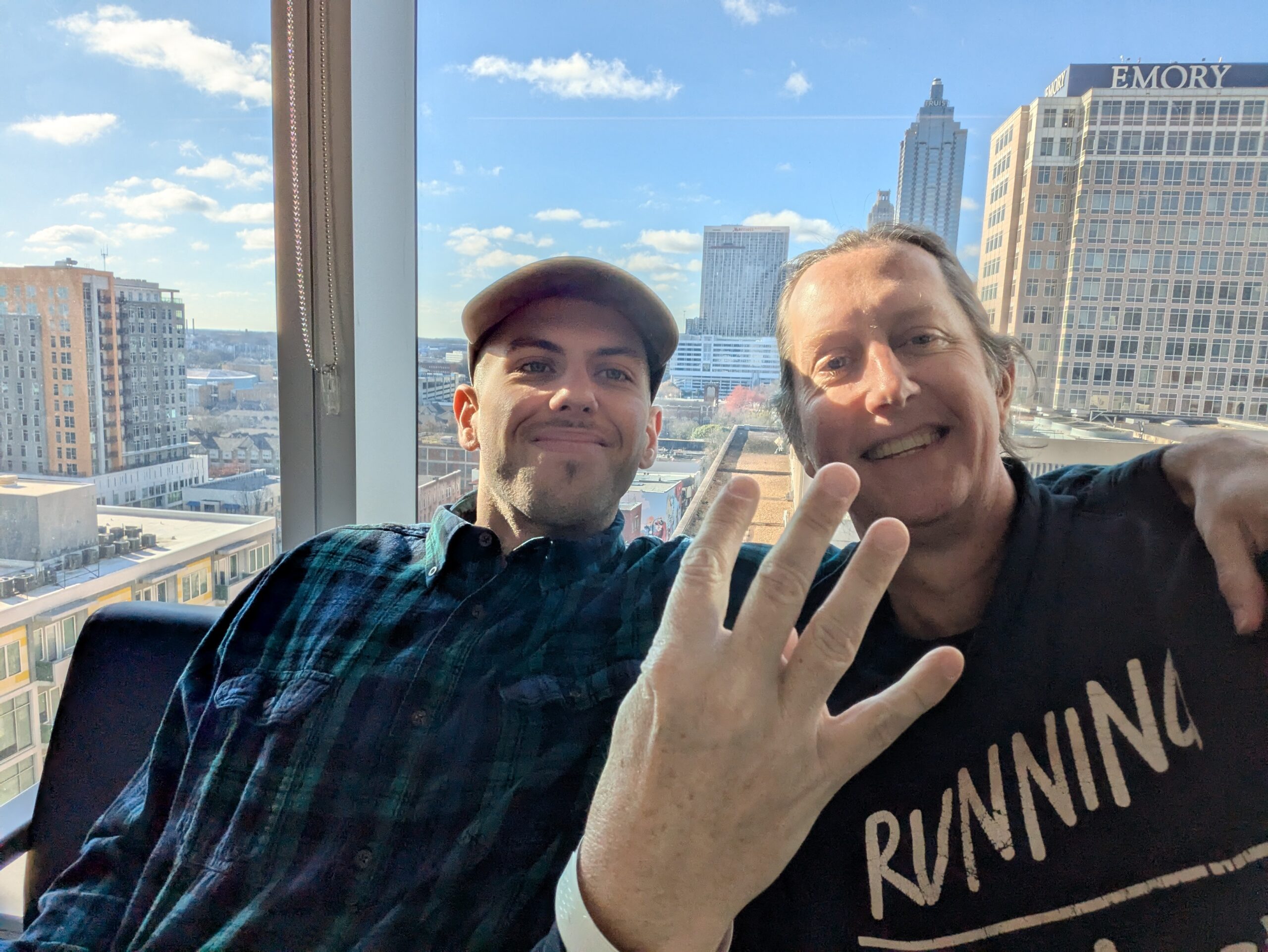
Image: Noah and me, chemo #4
At the end of treatment week #4, here are some things that I’m thinking about . . .
Joy
We are seeking it all the time, whether we know it or not. The barest minimum of joy can be found in pleasure: I love this yummy Starbucks drink, or this dessert, or this social media post about [fill in the blank]. Dopamine hits are a base kind of joy seeking. However, there are more complex neural networks that determine why we enjoy other things: how much work it took us to develop that taste or those skills to get to the enjoyment stage; how much time it took to develop relationships that led to the richness of this conversation; or how learning and emotion accumulates over a period of time to make the time that you’re with someone quietly or excitedly joyful. I had at least four specific moments of deep enjoyment this week — one, with my oldest son Noah taking me to chemotherapy; another, having my friend Ori prepare a meal and sit with all of us for dinner (Jenn, her kids, and my kids); another, playing a new game I bought (a very quiet, artsy, thinky game called Harmonies) with Jenn; another, having a two hour long video meeting with friends in our book-ish club (about Everett’s novel James). Since I have thought and written a good bit lately about noticing the absence of joy related to eating and food during treatment, it’s important to balance the scales. These other enjoyments count more right now because of the absent ones.
Friends
I keep getting to see cool people all the time because of the treatment ride schedule requests I sent out to my friends back in January. This week, I got to hang out with Jenn’s closest friend, my oldest friend, one of my kids, and one half of a couple that Jenn and I have really enjoyed getting to know the last couple of years who just had their first baby. These are the people that show up at my house at 2.30 every afternoon to give me a ride. Like clockwork; punctual AF (which I love). We have these curious conversations in the car that bookend my treatment time. In one, I got to draft out my short argument for how good The Brutalist is and why it should have won Best Picture. In another we drilled down into the specifics how a friend’s life has changed since their kids moved out of the house. I’ve had lots of people in my life tell me that I don’t ask for anything, that I avoid letting people know when I want or need something. While that may be true, this support network schedule was me just throwing open the “take care of me” doors, and it’s felt really good to let that happen.
Feeling it
That all makes this week sound like it’s been great, and, it’s true, those moments have been really recharging. At the same time, this week was the week where treatment got real. While the first pain started happening at the end of week two, we pretty quickly managed that with meds. Since then, the irritation focused mostly on my throat fluctuates but stays below a dull roar. It’s uncomfortable, but it’s not cringe worthy. The difficulty eating and the concerns about weight loss became central this week. Basically, when your mouth and throat hurt, and you’re nauseous, and you can’t taste what you’re chewing, you don’t want to eat. Forcing yourself to eat isn’t just annoying, it’s physically challenging because your body doesn’t want it. I’ve lost somewhere between 8 and 10 lbs this week. One doctor said: “If you drop two pounds next week, we’re ok. If you drop another 10lbs, we have to start looking at other options.” That’s the stomach feeding tube option he’s referencing. But there’s another change in there for me: I no longer think of that option, if it has to happen, as a failure on my part. If it happens, it happens, and we’ll go on from there. I’ll just stubbornly try to keep up my calorie intake as much as I can, and if that’s not enough, that’s ok.
But also: get ready
This was also the week that I heard from two people on my medical team some version of “I don’t want to lie to you: it’s going to get worse from here.” According to them, I have more pain, more eating and weight loss concerns, and more fatigue ahead. Which brings me to a realization. There was something happening in my head when we went through all of the intake appointments, reading, and basic enculturation necessary to becoming a cancer patient; I would hear or read these phrases like “for some people, the side effects are pretty mild or nonexistent” and I would seize on them. That’s me, I would think. I’m the lucky duck who will have all of this mayhem just slide off his back. I’m young and strong. I didn’t take seriously that going through treatment was going to be really hard; challenging, yes, but not like a full stare down with pain and suffering. Maybe because I have never experienced that before in my life. I’ve missed a lot of tragic events. I carry a lot of unearned privilege. But when I look at where I am now, and I hear the team saying, with a look of experience and care, buckle up because it’s going to be hard in this second half, I realize it’s coming. I appreciate the preparation, because I prefer honesty to pleasantry.
You get to choose
At the end of the day, I’m still me through this. My therapist prepared me for this (and so many other things) with a conversation about how every day before treatment starts and every day during treatment, I get to decide what my priorities are going to be and how I want to face challenges. Some of that might break down in the moment, and in the end, it’s all just plans, but making choices about who you want to before things get hard is helpful. Back then (several weeks ago) I decided: I don’t want being uncomfortable or in pain to make me into a rude or irritable person; I want to keep paying attention to things that give me joy (music, movies, art, colors); I want to keep my mind limber (mostly by reading and meditating); and I want to maintain my fight, I don’t want to feel like I’m giving up. So far, I think, I’ve been able to stick to those.
News embargo
One big change I made to my life in the middle of December when I was diagnosed: I stopped reading the news. Like, literally, all of it. For someone who has always had a journalistic orientation (writing for a newspaper was, in fact, my first job out of college) and became a rabid news devourer in the Trump Era, this was hard at first. But it’s not anymore, and it’s yielded great benefits. I don’t recommend everyone do it; I need a lot of you out there making sure I know when it’s time to revolt. But, avoiding the infinite scroll of the NYT, not hearing three or more hours of NPR every day has been really good for me. It’s giving me perspective, and it’s helping me feel less like I’m stuck in a system that I can’t change. For all the benefits a robust journalistic ecosystem gives us, it does also results in some brainwashing, whether it has a liberal flavor or a conservative one.
*****
Also, I updated my Spotify playlist to include my Week #4 artists that I listen to during treatment.
Thanks for reading. Keep your days full of adventure : )