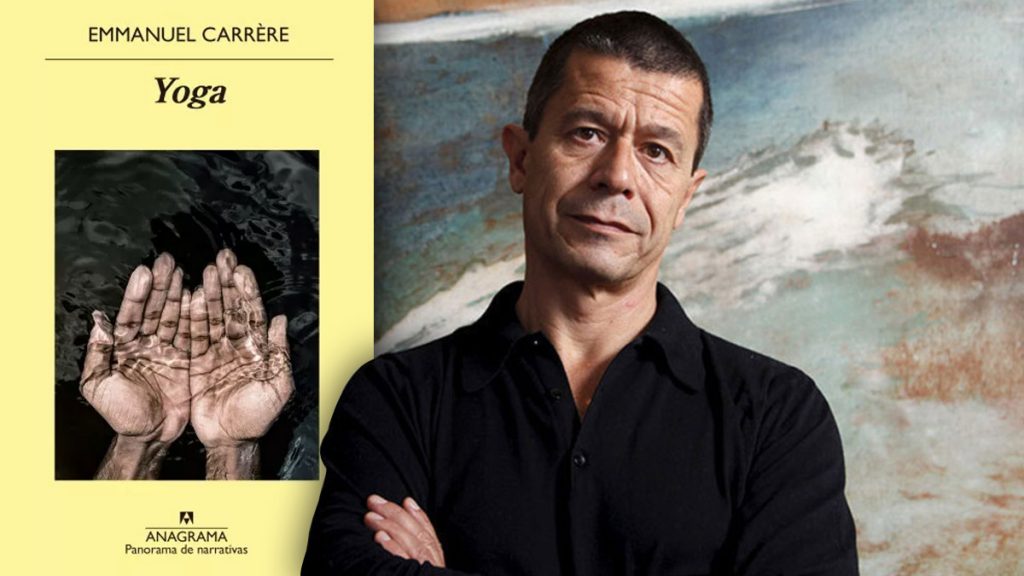
Image: Emmanuel Carrère, courtesy of elojocritica via CC license
This is usually the kind of post I would put on the main page of my blog, but since it relates to my treatment (which I’m trying to keep from “front page news” status), I’m posting it here.
Given that I’ve been reading Emmanuel Carrère memoir Yoga (I’ll be covering him in another, non treatment related post soon but also at the end of this post), I’ve gained some motivation to write something about what’s going on for me internally, and to develop the idea into something that perhaps you, as a reader, might identify with – or, even more productively, might find strange and productively disorienting.
To draw this out narratively, I’m going to introduce two characters. The first you can think of as a police officer, a boss, a coach, or a therapist. In different ways, our motives or intentions show up to serve these roles. It might threaten us, inspire us, or recommend different courses of action. It can be a tyrant or wise advisor, but it’s ideas come from outside of us. It speaks for the world, and if you’ve grown up like me, it has the certain flavor of capitalist, productivity culture, normative influences that we are often bombarded with. This voice often speaks to me, whether threateningly or collegially, from a place of measurement and assessment. From the place of “getting better.” It is often (though not always, depending on your relationship with joy and with work) what makes you write a detailed email to a colleague, go on a run, go to the doctor, or . . . I don’t know, invest money in something (disclosure: I don’t know anything about that). Though, it can also be the impetus for planning a vacation, shopping for a gift, or reading a book that everyone tells you that you should read. (See, not all bad.) Either way, this is our inner boss.
Our second character is our desire. It doesn’t tell us what to do; it just shows up with wants, and it has no plans beyond its own pleasure. It is the Buddha, but it can also be the addict. It is the spontaneous afternoon out for beers at the patio bar that turns into a romp through town, a concert, and a singalong at home with friends, hours later. It is an unplanned conversation on the bus that leaves you with a lot to think about. It is serendipity. This character seeks joy, but it has no concern for the impact of that joy, and also, because this is a story that is also about depression and cancer treatment, it is the character that sometimes seeks “joy” in avoiding or escaping. It is sometimes the depression that tells you that you don’t have to get out of bed. Desire can be negative. It can be the desire to get away from things as much as run towards them. And this character, I’m going to give a name: Bartleby, from the Herman Melville short story (it gives me anti-capitalist glee to be reminded that it’s actually titled: “Bartleby, the Scrivener: A Story of Wall-Street”). Everyone who has ever studied 19th century American Literature knows that what Bartleby always says, to every suggestion and request from the boss: “I prefer not to.”
Over the last several weeks I have had many internal conversations with these characters, Bartleby and the boss. Go for a walk, take your medicine, keep up with the scholarship happening in your field, clean this or that, take a shower, call a friend, mow the lawn, journal, meditate, keep sharp, make some art, the boss says. Bartleby: I prefer not to (except in the case of medicine and going to treatment, which, so far, I attack with drone-like willingness). Bartleby doesn’t want to do it, he just doesn’t. What does he want to do instead? What does he think he’ll get out of this withdrawal and avoidance? Everyone wants to know, really. But he doesn’t think like that. In truth, months ago Bartleby was the one prompting me out to the bar, or binging all of Succession in three weeks (to the detriment of me believing any of us are ok for a couple of other weeks after that), or jumping on my bike for a two hour ride in the middle of a work day. In this new iteration of the character (which, sure, I’ll agree does not correspond at all with Melville’s version), Bartleby can be about joy and pleasure seeking. He can be what my daughter at the age of five used to call “humbateetees”; humbateetees, as she told us, were “everything I like.”
The truth is though, for months before I was diagnosed with cancer, maybe something like half a year or more, I was experiencing a depression that was more sustained than my usual lighter and quicker stretches of feeling “flat”. My therapist categories my experiences with depression as dysthymia, and a pretty light version of it. (Iincidentally, I felt very seen but also like the hipster party was over, when the NYT published an article about it two years ago. Like: oh now, everyone has this, and I can’t be the cool one that knew that band first.) If I reflect on the last five years of my life, in light of how I have been feeling, the following events stand out: a pandemic that totally and completely locked us out of the realness and normalcy of our lives (2020), the death of my best friend (2022), a sudden and life threatening family illness (my dad, 2023), another sudden and life threatening family illness (my son, 2024), and my own cancer diagnosis and treatment (2024-2025). This is not to say that the same period of time did not also contain joyful, life-giving moments and milestones as well (my relationship with my partner Jenn, Noah’s sobriety, Eden and Ian’s wedding, all of Micah’s new art, tattoos, and radio station work, seeing my mom and dad regularly and constantly joking about them moving into my backyard, my regular schedule of parties and book clubs, and my brilliant and beautiful friends and the community they are always bringing to me). But, by spring of last year, I was heading into a feeling of flat numbness that was taking over more than it usually does. I was in the Bartleby “I prefer not to” zone.
It might sound strange, but the cancer diagnosis and treatment preparations did not make my depression more profound; in a strange way, cancer erected a kind of battle narrative in my head. And, as anyone who knows me knows, I love a good fight. The underdog, The bullshit bureaucracies, the unfairness, the plans for success and the backup plans for success, the stitching together of communities of purpose, the resolve, the refusing to get kicked without landing my punches. I identify with agonism; it’s the punkness of it all. I can own that I like all of that, and that The Clash has often been my life-soundtrack through frustration into revelatory joy in watching bad things burn down. So, cancer was scary, but it was a story and a shot in the arm. It doesn’t feel responsible or intelligent to admit all of that, but it’s also a layer that, when I peel it back and look at it, I can’t ignore what’s underneath.
Now that I’m three weeks into cancer treatment, I’m in it. The trench. It’s not the trench of constant pain as you might imagine (that, I’ve heard, might be coming later, but it’s manageable now). It’s the trench of: what do you do with yourself when all day, every day, you don’t feel physically great and you don’t psychically great. This is where the boss and Bartleby come back in. The boss has a list of hundred things I told myself might be good to do during this time period (learn Spanish, buy a bass guitar and learn that, develop a book proposal for a publisher, become “that cancer guy” that goes on long walks just to stick it the disease, start painting, learn to cook new foods). You know what Bartleby says, right? I. Prefer. Not. To.
So, now I’d like to introduce a new character into this story, and this doesn’t need to be “the hopeful turn”. In fact, I’d like to hold myself back from that kind of moralizing here. But the third character in this story is me. Because, while I am both the boss and Bartleby, I am also neither the boss nor Bartleby. I prefer not to be. I’ve done enough meditation to know that those are just things that I think. And thoughts are great, but there are a million of them. I can think other things, or I can stand apart from the positions of the boss and of Bartleby and just watch them. Like clouds. And realize that they come and go, and that I can, if I choose, just sit here and attend to taking breaths. SHOULD I go start checking things off of a productivity list? SHOULD I stay in bed another three hours cycling through Netflix, railcam videos (here’s a yummy example), and r/solarpunk on Reddit (I’m currently on a news embargo; it’s going very well)? Well, that’s two SHOULDS – already a lot of SHOULDS. The third character in this story, me, the person breathing through all of this, is hopefully aware and alert enough some of the time to perceive that the decision of what to do belongs to him (um, me).
So, that person, me, I, the breathing person is filtering through a lot of “do this” and “I’d prefer not to.” In more normal times (let’s say, pre-pandemic, although it’s abundantly clear that we have gone through several new normals since then), I was used to the balance of suggestions from the boss and Bartleby being relatively equal, and I could choose at will. At different times over the last five years, and more frequently over the last year, the Bartleby voice really takes precedence. Last year, Jenn and I developed a code for these days where she would text to see how I was, I would say “just flat”, and we would know that we could talk about that later. But this cancer thing. I’m finding in the last several weeks that Bartleby is really ramping up, feeling himself, getting very comfortable. This third character, the me-part, is often just sitting and waiting – for meds to kick in, for it being time to force myself to eat (talk about a chore!), for the sun to come out brighter so that I can sit outside for a minute, for . . . something. And reading.
I was worried that reading a memoir about someone starting from a place of meditation, yoga, and stability who was then being plunged into a major depressive episode, a divorce, and total life trauma might be . . . poorly timed? But, I really love Emmanual Carrère’s writing so much (committing a second time to a post just on Carrère). It’s given me some encouragement to play with a different kind of writing (which, honestly, if you look at my early blogging in 2009, it’s probably more like going back to basics) in this post and, perhaps, future ones. It has let a fourth character into the room in my head, to liven up the party a little bit.
And, it’s worth mentioning, that the original idea for this post (written at 3am when I can’t sleep) came to me a couple of days ago on a walk. In something like just 25 steps of the walk, there the whole idea was in my head. Well, 70% of it. At that point, it was a post focused on what thinking “I don’t want to do that” really means and what it really does inside us, and I hope that I’ve captured that well here.